Mao and Stalin used similar tactics to rise to power. Some ways that Mao and Stalin are similar in the ways hey came to power are, they both were in the military and gained respect from the people fighting for their county. They both forced out a threat for them to gain power from their country, Mao forced out Chiang Kai-Shek and Stalin forced out Trotsky. This is how they compare in the ways they come to power.
Mao and Hitler compare in the ways they come to power. Some ways they compare are, they both served their country in the military and gained respect from their people. Once they had power they both made camps for the people that they didn't like. Also, they both had laws like, your free if you do what I say. This is how they compare in the ways they came to power.
There are signs to tell when a dictatorship is growing. One sign is, if the person is discriminating against a specific race, religion or government in ways that they want to wipe them off the face of the earth. Another way to tell is, if the person encourages people to be like them or dress like them and practically worship them. If the person drives someone out of that is running against them and could possibly be a threat to them winning an election then they might be trying to be a dictator. Lastly, if the person is constantly trying to declare a state of emergency so they could have absolute power. these are ways to tell when a dictatorship is forming.
Friday, December 21, 2007

Wednesday, December 19, 2007
local history rough draft
Yodelin’ Slim Clark
Ben Taylor
Ms. Lind and Mr. Viles
English/History
12/18/07
Outline
I. Introduction
A. Report subject
II. Biography of Slim Clark
A. Birth place
B. Starting music career
C. Family life
III. History of Yodeling
A. Relation to Slim Clark
B. Yodeling technique
C. Yodeling origin
IV. Wilf Carter (Montana Slim)
A. Influence of Slim Clark
B. Accomplishments
Ben Taylor
Ms. Lind/ Mr. Viles
English/History
12/18/07
Introduction
My report is on a former resident of St. Albans, Maine. His name was Raymond Clark. This report will talk about his lifestyle and how he became famous.
Slim Clark’s Biography
Raymond L. Clark, more commonly known as “Slim Clark”, was born in Springfield, Massachusetts in 1917. Ever since he could understand what they were singing about, Slim Clark had an interest in cowboy music. At the age of seven or eight, he decided that he wanted to be a cowboy singer. “I’d sit in the rocking chair and rock for hours listening to the old songs by Charlie Blake, John White, Jimmie Rodgers, and Bradley Kincaid.”
One day someone came along and taught him a few chords on the guitar. Those few chords were the only ones that he ever played. “I never became much of a guitar player, but for the type of song that I do and the style that I have and the crudeness of my delivery, the way that I play is very much in line with everything else, so I’ve never bothered to become much of a guitar player”, said Clark.
He completed two years of high school before he became a professional singer for the public in 1932 when he was only fifteen years old. Clark considered himself to be a cowboy
Taylor page 2
singer. “A cowboy is anyone who lives that type of life, no matter where he is”, he said. He started out singing with some of the local bands. “I use to get two dollars a night, pretty good money. Of course I had to walk four or five miles carrying a guitar case to get there”, said Clark. A few times a year some music groups went through the town and they had “cowboy shows”. Sometimes he would sing on stage and the music groups would ask him to travel with them and
he did. Around that same time there was a singer by the name of Montana Slim (aka Wilf Carter), and every day at 9:00 a.m., Clark would listen to him on the radio because that is what his idea of a cowboy singer was.
Clark first sang on a radio station in Massachusetts, and in 1938 he started more than a decade of performances on the radio station WKNE in New Hampshire. He went on the air as “Wyoming Buck”, but a few months later a radio station manager re-named him “Yodeling Slim Clark”, which he stuck with for the rest of his career. In the early ‘50’s he moved to Maine for the hunting and fishing he loved. He starred in the 1960’s on the station “RFD Dinnerbell” out of Bangor. At one point, Slim Clark was in the group “The Red River Rangers”. Later he had his own band “The Trail Riders” with Dick Curless, who played rhythm guitar and he was in another band called the “Tralesmen”. They played throughout New England, New York and New Jersey. He made his first record in 1946 after signing with Continental Records in New York City. He gained popularity in the United States, Canada, Australia, New Zealand, and Europe
with only a few performances outside of New England. Shortly after his death, Clark’s first CD was released. Clark wrote more than 100 songs in his lifetime.
He sang at a dude ranch and use to lead trail rides and entertained tourists on the rides.
Taylor page 3
“I had all kinds of chances to be up there on the top shelf, but it required staying and living in the big city, playing clubs, meeting with people all the time, and I was too much of a country boy to stand for that,” said Clark. The way he saw it was, hunting and fishing came first because if he couldn’t do those things than he would be unhappy and than he couldn’t do his job.
During the hunting and fishing seasons he would go out in the woods and the people he worked with couldn’t get a hold of him so they would just wait until he came back.
Some of the biggest influences on Slim Clark’s singing were Jimmie Rodgers and Wilf Carter. They were the ones who helped him decide to be a cowboy singer.
Slim Clark is in the Yodeler’s Hall of Fame, The Western Music Association’s Hall of Fame, The Country Music Hall of Fame and the Cowboy Hall of Fame.
Clark was also a big sports fan and he once tried out as a pitcher for the Boston braves, now known as the Atlanta Braves.
In 1943 Clark was married to Celia Jo Roberson Clark and they had two kids, a son named Wilf Carter Clark and a daughter named Jewel LaVerne Clark. They also both enjoy singing and playing country music. He went through a divorce in 1968 and then married Kathleen M. Pigeon Clark in 1981. Kathleen Clark now lives in St. Albans and has a chiropractic office in Hartland.
Some jobs that he had other than singing include being a Maine guide to hunters and fishers and he worked in a factory.
He didn’t like with the way country music started changing from country to pop and country rock, “it got out of hand for me”. Said Clark.
Taylor page 4
He wrote that he loved to go to the festivals and shows and meet the people but he didn’t like to travel too far to get there. He didn’t like to wait to sing either when he could be doing something else.
Late in life, Clark still performed at fairs and festivals up and down the eastern seaboard.
He also loved to paint, he liked to paint the outdoors, wildlife, hunting and fishing, old country
homes and farms, country roads, old logging scenes. He liked to paint “the old days, the horse and drag days, things like that, and the log-hauling days. I like to paint those particular types of pictures. Especially deer and landscapes.” He Said. Some other hobbies that he liked were hunting, fishing and golf. He once played fifty-six holes of golf in one day.
Slim Clark was a man of faith and a lot of his songs had a Christian meaning to them.
He wrote in his autobiography, “If I had to do it all over again, I would do the same thing…perhaps a little differently, but basically the same.” Clark’s life ended on July 5, 2000.
The History of Yodeling
Yodeling is the style of singing that Slim Clark sang. He grew up listening to it and knew that was the style of music he would one day like to play and entertain with.
Yodeling is a style of singing that involves an extended note which rapidly and repeatedly changes in pitch making a high, low, high, low sound.
The style of yodeling originated in the Swiss Alps. The Swiss Alps are in central Switzerland and continue to grow a little bit every year. There are a number of individual
Taylor page 5
mountains that make up the Swiss Alps. Today the Swiss Alps are a popular tourist attraction because of the hiking, climbing and even a train that you can ride to get a view of the mountains.
Yodeling started when the people in Switzerland use to yodel to communicate between mountaintops. They would use a series of short yells that would mean something such as, “It’s time for dinner”. They were never really saying anything. A certain series of yells would mean a
certain thing. Eventually they decided that they liked the sound of it and they turned it into a singing art. To this day, most of the time they are not saying anything in traditional style yodeling like in Switzerland and in Austria.
Yodeling is used in European folk music and many other cultures throughout the world, including American bluegrass and country music.
Wilf Carter (Montana Slim)
Wilf Carter was one of Slim Clark’s biggest influences on his singing.
Wilf Carter, or Montana Slim, was a Canadian country singer, yodeler and a songwriter like Slim Clark. Carter was Canada’s first country music star. He recorded over forty records and
in 1983, he re-recorded his top hits onto one album, Fifty Golden Years. In 1971 he was inducted
into the Nashvill Songwriters Hall of Fame and in 1984 he was inducted into the Canadian Music Hall of Fame.
Taylor
Bibleography
Works Cited
Internet
1) Clark, Raymond L. "Yodeling Slim Clark." 20 Nov. 2007
2) Cleary, Don. "Yodeling Slim Clark." New England Music Scrapbook. 19 Nov. 2007.
3) "Wilf Carter." Wikipedia. 6 Dec. 2007.
4) "Yodeling." Wikipedia. 20 Nov. 2007.
5) "Yodelin Slim Clark." Wikipedia. 25 Nov. 2007.
Interview
1) Clark, Kathleen. 12/8/07.
Taylor
Bibliography
Works Consulted
Internet
1) "The Swiss Alps." Articles Directory. 1 Dec. 2007.
2) Keller, Florian. "Yodeling: an Art Form of the Alps." Vienna Online. June 1999. 29 Nov. 2007.
Book
1) Biglow, M. Gladys. Knowles, M, Ruth. History of St. Albans Maine, Heritage Books, INC., Bowie, Maryland, 2003
Ben Taylor
Ms. Lind and Mr. Viles
English/History
12/18/07
Outline
I. Introduction
A. Report subject
II. Biography of Slim Clark
A. Birth place
B. Starting music career
C. Family life
III. History of Yodeling
A. Relation to Slim Clark
B. Yodeling technique
C. Yodeling origin
IV. Wilf Carter (Montana Slim)
A. Influence of Slim Clark
B. Accomplishments
Ben Taylor
Ms. Lind/ Mr. Viles
English/History
12/18/07
Introduction
My report is on a former resident of St. Albans, Maine. His name was Raymond Clark. This report will talk about his lifestyle and how he became famous.
Slim Clark’s Biography
Raymond L. Clark, more commonly known as “Slim Clark”, was born in Springfield, Massachusetts in 1917. Ever since he could understand what they were singing about, Slim Clark had an interest in cowboy music. At the age of seven or eight, he decided that he wanted to be a cowboy singer. “I’d sit in the rocking chair and rock for hours listening to the old songs by Charlie Blake, John White, Jimmie Rodgers, and Bradley Kincaid.”
One day someone came along and taught him a few chords on the guitar. Those few chords were the only ones that he ever played. “I never became much of a guitar player, but for the type of song that I do and the style that I have and the crudeness of my delivery, the way that I play is very much in line with everything else, so I’ve never bothered to become much of a guitar player”, said Clark.
He completed two years of high school before he became a professional singer for the public in 1932 when he was only fifteen years old. Clark considered himself to be a cowboy
Taylor page 2
singer. “A cowboy is anyone who lives that type of life, no matter where he is”, he said. He started out singing with some of the local bands. “I use to get two dollars a night, pretty good money. Of course I had to walk four or five miles carrying a guitar case to get there”, said Clark. A few times a year some music groups went through the town and they had “cowboy shows”. Sometimes he would sing on stage and the music groups would ask him to travel with them and
he did. Around that same time there was a singer by the name of Montana Slim (aka Wilf Carter), and every day at 9:00 a.m., Clark would listen to him on the radio because that is what his idea of a cowboy singer was.
Clark first sang on a radio station in Massachusetts, and in 1938 he started more than a decade of performances on the radio station WKNE in New Hampshire. He went on the air as “Wyoming Buck”, but a few months later a radio station manager re-named him “Yodeling Slim Clark”, which he stuck with for the rest of his career. In the early ‘50’s he moved to Maine for the hunting and fishing he loved. He starred in the 1960’s on the station “RFD Dinnerbell” out of Bangor. At one point, Slim Clark was in the group “The Red River Rangers”. Later he had his own band “The Trail Riders” with Dick Curless, who played rhythm guitar and he was in another band called the “Tralesmen”. They played throughout New England, New York and New Jersey. He made his first record in 1946 after signing with Continental Records in New York City. He gained popularity in the United States, Canada, Australia, New Zealand, and Europe
with only a few performances outside of New England. Shortly after his death, Clark’s first CD was released. Clark wrote more than 100 songs in his lifetime.
He sang at a dude ranch and use to lead trail rides and entertained tourists on the rides.
Taylor page 3
“I had all kinds of chances to be up there on the top shelf, but it required staying and living in the big city, playing clubs, meeting with people all the time, and I was too much of a country boy to stand for that,” said Clark. The way he saw it was, hunting and fishing came first because if he couldn’t do those things than he would be unhappy and than he couldn’t do his job.
During the hunting and fishing seasons he would go out in the woods and the people he worked with couldn’t get a hold of him so they would just wait until he came back.
Some of the biggest influences on Slim Clark’s singing were Jimmie Rodgers and Wilf Carter. They were the ones who helped him decide to be a cowboy singer.
Slim Clark is in the Yodeler’s Hall of Fame, The Western Music Association’s Hall of Fame, The Country Music Hall of Fame and the Cowboy Hall of Fame.
Clark was also a big sports fan and he once tried out as a pitcher for the Boston braves, now known as the Atlanta Braves.
In 1943 Clark was married to Celia Jo Roberson Clark and they had two kids, a son named Wilf Carter Clark and a daughter named Jewel LaVerne Clark. They also both enjoy singing and playing country music. He went through a divorce in 1968 and then married Kathleen M. Pigeon Clark in 1981. Kathleen Clark now lives in St. Albans and has a chiropractic office in Hartland.
Some jobs that he had other than singing include being a Maine guide to hunters and fishers and he worked in a factory.
He didn’t like with the way country music started changing from country to pop and country rock, “it got out of hand for me”. Said Clark.
Taylor page 4
He wrote that he loved to go to the festivals and shows and meet the people but he didn’t like to travel too far to get there. He didn’t like to wait to sing either when he could be doing something else.
Late in life, Clark still performed at fairs and festivals up and down the eastern seaboard.
He also loved to paint, he liked to paint the outdoors, wildlife, hunting and fishing, old country
homes and farms, country roads, old logging scenes. He liked to paint “the old days, the horse and drag days, things like that, and the log-hauling days. I like to paint those particular types of pictures. Especially deer and landscapes.” He Said. Some other hobbies that he liked were hunting, fishing and golf. He once played fifty-six holes of golf in one day.
Slim Clark was a man of faith and a lot of his songs had a Christian meaning to them.
He wrote in his autobiography, “If I had to do it all over again, I would do the same thing…perhaps a little differently, but basically the same.” Clark’s life ended on July 5, 2000.
The History of Yodeling
Yodeling is the style of singing that Slim Clark sang. He grew up listening to it and knew that was the style of music he would one day like to play and entertain with.
Yodeling is a style of singing that involves an extended note which rapidly and repeatedly changes in pitch making a high, low, high, low sound.
The style of yodeling originated in the Swiss Alps. The Swiss Alps are in central Switzerland and continue to grow a little bit every year. There are a number of individual
Taylor page 5
mountains that make up the Swiss Alps. Today the Swiss Alps are a popular tourist attraction because of the hiking, climbing and even a train that you can ride to get a view of the mountains.
Yodeling started when the people in Switzerland use to yodel to communicate between mountaintops. They would use a series of short yells that would mean something such as, “It’s time for dinner”. They were never really saying anything. A certain series of yells would mean a
certain thing. Eventually they decided that they liked the sound of it and they turned it into a singing art. To this day, most of the time they are not saying anything in traditional style yodeling like in Switzerland and in Austria.
Yodeling is used in European folk music and many other cultures throughout the world, including American bluegrass and country music.
Wilf Carter (Montana Slim)
Wilf Carter was one of Slim Clark’s biggest influences on his singing.
Wilf Carter, or Montana Slim, was a Canadian country singer, yodeler and a songwriter like Slim Clark. Carter was Canada’s first country music star. He recorded over forty records and
in 1983, he re-recorded his top hits onto one album, Fifty Golden Years. In 1971 he was inducted
into the Nashvill Songwriters Hall of Fame and in 1984 he was inducted into the Canadian Music Hall of Fame.
Taylor
Bibleography
Works Cited
Internet
1) Clark, Raymond L. "Yodeling Slim Clark." 20 Nov. 2007
2) Cleary, Don. "Yodeling Slim Clark." New England Music Scrapbook. 19 Nov. 2007
3) "Wilf Carter." Wikipedia. 6 Dec. 2007
4) "Yodeling." Wikipedia. 20 Nov. 2007
5) "Yodelin Slim Clark." Wikipedia. 25 Nov. 2007
Interview
1) Clark, Kathleen. 12/8/07.
Taylor
Bibliography
Works Consulted
Internet
1) "The Swiss Alps." Articles Directory. 1 Dec. 2007
2) Keller, Florian. "Yodeling: an Art Form of the Alps." Vienna Online. June 1999. 29 Nov. 2007
Book
1) Biglow, M. Gladys. Knowles, M, Ruth. History of St. Albans Maine, Heritage Books, INC., Bowie, Maryland, 2003
Thursday, December 13, 2007
Exam essays
Prompt 2
Propaganda is a picture that makes you proud of your country off fighting. It can also be a picture that makes you hate the country that your countey is fighting and makes you want to go fight. Art is just a picture the someone draws or paints for no purpose other than for pleasure or to sell. I think that Guernica is art because it is what Picasso sees in the war, I think that what is in the picture is what the war looks like through his eyes.
In the picture I see a number of people, all of them have a hurt or sad look on their face. I see a horse and a bull that are eather in pain or dead so I can assume that many animals died durring this war. Everything looks verry disorganised and hecktic because there were bombs constantly going off. The picture as a whole has very dark colors to is so this must have been a very sad time.
The bombing of Guernica was when the Germans and Italians arial attacked Guernica. Guernica is a town in Spain, the attacks happened in 1937, durring the Spanish Civil war. By the end of the bombings, there were 1,654 dead (a third of the population) and 889 wounded.
Prompt 3
Hitler and the Nazis came to power by burning the reichstag, they did it and then blamed it on a Jewish man, he then stated a state of emergency and was elected into absolute power. The conditions were also good for them because Germany was in debt from the 1st world war and many familys were in poverty. Hitler brought the country and the familys out of poverty so the people liked him.
The great depression was a chance for the Nazi party go get the population on their side because the people were getting tired of the depression and were willing to try anything. Hitler gave unimployed people jobs, he got rid of the chaos and many other things that made the people love him. When he made decisions, the people always supported him because of what he did for the country.
The people of Germany did not rise agenst Hitler because he continued to protect them form unimployment and poverty. The people had better living conditions, health care and there was less crime. Also, the people liked the soldiers walking around sharply dressed and knowing that they were defending their land.
Propaganda is a picture that makes you proud of your country off fighting. It can also be a picture that makes you hate the country that your countey is fighting and makes you want to go fight. Art is just a picture the someone draws or paints for no purpose other than for pleasure or to sell. I think that Guernica is art because it is what Picasso sees in the war, I think that what is in the picture is what the war looks like through his eyes.
In the picture I see a number of people, all of them have a hurt or sad look on their face. I see a horse and a bull that are eather in pain or dead so I can assume that many animals died durring this war. Everything looks verry disorganised and hecktic because there were bombs constantly going off. The picture as a whole has very dark colors to is so this must have been a very sad time.
The bombing of Guernica was when the Germans and Italians arial attacked Guernica. Guernica is a town in Spain, the attacks happened in 1937, durring the Spanish Civil war. By the end of the bombings, there were 1,654 dead (a third of the population) and 889 wounded.
Prompt 3
Hitler and the Nazis came to power by burning the reichstag, they did it and then blamed it on a Jewish man, he then stated a state of emergency and was elected into absolute power. The conditions were also good for them because Germany was in debt from the 1st world war and many familys were in poverty. Hitler brought the country and the familys out of poverty so the people liked him.
The great depression was a chance for the Nazi party go get the population on their side because the people were getting tired of the depression and were willing to try anything. Hitler gave unimployed people jobs, he got rid of the chaos and many other things that made the people love him. When he made decisions, the people always supported him because of what he did for the country.
The people of Germany did not rise agenst Hitler because he continued to protect them form unimployment and poverty. The people had better living conditions, health care and there was less crime. Also, the people liked the soldiers walking around sharply dressed and knowing that they were defending their land.
Thursday, November 29, 2007
Friday, November 16, 2007
STALINGRAD
Questions
- What does Joseph Stalin's advice to the people of Stalingrad say about him as a leader?
- Explain why Hitler would react in the way shown after signing a Non-Aggression Pact with Stalin?
- Explain the significance of propaganda in this battle, using examples from the posters.
- What do the extremes of the war reveal about what it takes to win a total war?
- How does the story of Vasily Zaitsev relate to the war in Iraq?
- In times of crisis, sometimes heroic figures emerge. Which figure emerged in a similar way to Vasily after the terrorist attacks of 9/11?
Answers
1. He is a firm leader, he values nothing but himself and to win.
2. Hitler can attack them without them expecting it because they think that he is on their side because of the non-agerssion pact.
1. He is a firm leader, he values nothing but himself and to win.
2. Hitler can attack them without them expecting it because they think that he is on their side because of the non-agerssion pact.
3. The people would see the posters and they would keep the people motavated to fight.
4. Sacrafice, bad living conditions and to have the will power to tough out the hard times.
5. The Iraqis belive to be defending their home land from the invaders (us) like Vasily Zaitsev was.
6. The firemen, the police men and all who helped.
Thursday, October 18, 2007
Exam II
The Columbian Exchange transformed the world in a more radical (to make extreme changes in existing views, habits, conditions) way than any other development in world history. One significant effect of this process (something going on) was the establishment of the Triangle Trade. While many factors were a part of the Triangle Trade, the rapid growth in both supply and demand for new commodities was the largest motivating element. This time period may be best associated (related to) with economic developments, but it is impossible to analyze (to examine critically) this period without considering the intense social impact that the Triangle Trade had on those involved. In truth, a full understanding can only be gained by appreciating (to be grateful or thankful for) how economic and social factors (One that actively contributes to an accomplishment) impact each other in history.
The Columbian Exchange (an enormous exchange of plants, animals and food) transformed the world in a more extreme way than any other event in world history. One important thing that went on was the triangle trade (in history, a trade rout between the America, Europe, and Africa). Even though there were a lot of things that helped in the triangel trade, the two biggest ones were supply and demand for new products. This time period might be most related with the development of distributation of goods and services, but it is imposable to examine this period in time without looking at the social effect that the triangle trade had on those included. Truthly, one can only compleatly understand by being greatfull for how economic and social factors effect each other in history.
The Columbian Exchange (an enormous exchange of plants, animals and food) transformed the world in a more extreme way than any other event in world history. One important thing that went on was the triangle trade (in history, a trade rout between the America, Europe, and Africa). Even though there were a lot of things that helped in the triangel trade, the two biggest ones were supply and demand for new products. This time period might be most related with the development of distributation of goods and services, but it is imposable to examine this period in time without looking at the social effect that the triangle trade had on those included. Truthly, one can only compleatly understand by being greatfull for how economic and social factors effect each other in history.
Monday, October 15, 2007
book project
Ben Taylor
Hunger RTL
Hunger RTL
In the documentary, Hunger by Sherman Apt Russell she tells how hunger has affected the world and how it is still affecting the world. In this book the author uses a number of examples to show how hunger has affected the world. Some of the examples include, Gandhi and his hunger protests where he protested by starving himself. Another example is when a few men, instead of going to war (WWII) volunteered to starve themselves so the soldiers would know how to feed the starving people at the concentration camps without making them sick or die. The theme of this book is, teaching you the dangers of starving, this is important because it tells you what happens to your body when you starve.
In this book Sherman Apt Russell uses many different mini-stories to (Gandhi) develop the theme. One of the stories is between the
 years 1869 and 1948 when Gandhi starved himself in protest to get things he wanted for himself or his people. Another story in this book is when a number of men in the WWII era (early 1940's) volunteered to starve themselves so the soldiers would know how to reefed the starving people in the concentration camps without making them sick or die all of the men lived however, many of them went crazy and changed there majors to food and read cook books. Another story in this book is about the potato famine. During the potato famine in 1846, a large crop (60%-75%) of potatoes was contaminated the potatoes turned into a smelly mush. Many people died because; in Ireland the potato was a large part of their diet.
I can connect to this book because while I was reading this book it made me think about how hunger can affect the body and the mind. It affects the body because after so long the body eventually eats it’s self. It affects the mind because food suddenly becomes the center of attention and that’s all you can focus on.
This book is very believable because it is all true facts. All the characters were real people and they all showed the theme because all the people she wrote about were starving. In all the examples I gave above, the people were real and the people were starve and dieing.
Thursday, September 27, 2007
exam
 This is the first image i chose to look at for the French Revolution. In this image, it shows the people going through the streets and everyone looks happy as if they had just won a battle. Next, the streets are crowded and there are a lot of large buildings so they must be in a city. Also the soldiers are wearing blue uniforms so more than likely they are fighting for the king.
  This is the second image I chose to look at for the french revolution. In this image, there are lots of buildings so they are fighting in a populated place, they didn't go to a field to fight. It appears to be at night so that tells you that they fought in all hours of the day. Last, There are many fires in the battle so some of the fighters may have been using torches as weapons.
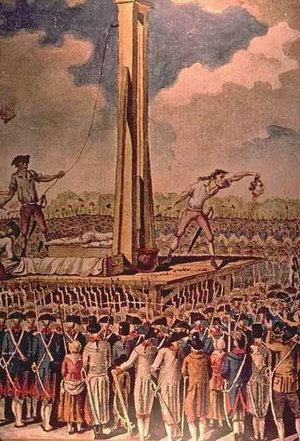 This is the last image I chose to look at. In this image, there is a guillotine so it has to be after the year 1972. Also, most of the people there are soldiers with uniforms on so they are fighting for the king so the victim is most likely a citizen. Last, there are many people there so the person being killed might be an important person.
You can just look at an image and it will tell a story. With these three images you can have an idea of what it was like during the french revolution just by looking at the pictures.


Friday, September 21, 2007
industral revolution

In this photo I can tell that it is later because it is a photo. The building is five stories tall so that also shows that they had the technology to build a building that tall. They use horses and buggies so they dont have the car yet or only the rich have them.
Wednesday, September 12, 2007
project proposal
topic: modern day slavery
angle: indentured child slavery
medium: movie about children who work as slaves because their parents owe money to the slave owner
with Ethan
angle: indentured child slavery
medium: movie about children who work as slaves because their parents owe money to the slave owner
with Ethan
Friday, September 7, 2007
How comfortable I am using tecnology
I am comfortable using technology in the class and I think I will like not worrying about bringing supplies to class
Subscribe to:
Posts (Atom)